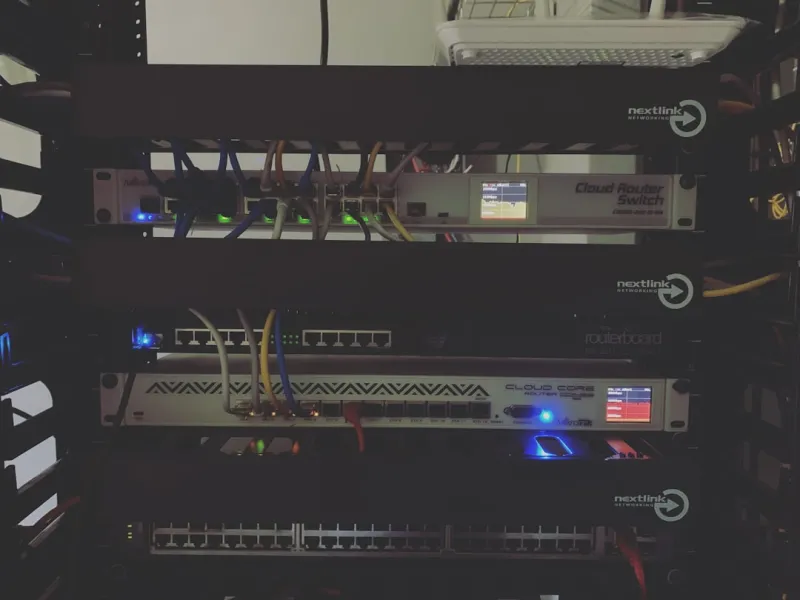
When I first set up my home office back in the early 2020s, I thought a decent router and a solid Ethernet cable were the apex of networking sophistication. Fast forward to 2026, and that modest setup feels like a relic in a museum of analog ambition. Today, every packet that zips across our LANs is being examined, prioritized, and sometimes even predicted by layers of AI that sit snugly between the switch and the cloud. This shift isn’t just a tech fad; it’s a fundamental re‑architecture that’s redefining latency, reliability, and security for both enterprises and home users alike. In my experience, the most successful networks now blend hardware that’s built for modular expansion with software that can learn traffic patterns on the fly, making “plug‑and‑play” a thing of the past and “plug‑and‑optimize” the new mantra.
Hardware Has Gotten Smarter, Not Just Faster
Modern routers and switches are no longer static devices that merely forward bits; they’re essentially miniature data‑centers packed with dedicated AI accelerators. The latest edge‑focused devices can run inference models directly on the hardware, allowing them to detect anomalies or classify traffic before it even leaves the premises. Coupled with the rise of SD‑WAN, network administrators now have a single pane of glass that can re‑route traffic in real time based on congestion, cost, or security posture. In practice, this means my own home network can automatically shift a heavy 4K streaming session to a separate VLAN, keeping my work‑from‑home video calls crisp and uninterrupted. The hardware evolution also embraces open standards like OpenConfig, which let you script configuration changes with the same agility you’d expect from a cloud API—something that would have been unimaginable just a few years ago.
AI‑Powered Automation Is the New Network Engineer
One of the biggest paradigm shifts I’ve witnessed is the migration from manual policy tweaking to AI‑driven automation. By feeding real‑time telemetry into machine‑learning models, networks can now predict congestion spikes before they happen and pre‑emptively allocate bandwidth. This isn’t speculative; it’s a concrete capability that’s already being rolled out in enterprise environments. For those curious about the broader implications, check out AI‑Powered, Future‑Proof Connections, which dives deeper into how these models are trained and deployed. In my own setup, I’ve configured a lightweight neural net on my home router that learns my household’s daily bandwidth usage patterns and dynamically adjusts QoS rules, ensuring my kids can game without sacrificing my video conference quality. The result is a self‑healing network that feels almost sentient, reducing the need for constant manual intervention.
The Security Landscape Has Been Redrawn by AI
While AI brings efficiency, it also invites a new class of threats that are more adaptive and stealthy than traditional malware. Attackers now employ generative models to craft polymorphic payloads that can slip past signature‑based defenses in seconds. This arms race has forced network security to become more proactive, leveraging behavior‑based detection and zero‑trust architectures at the edge. In my day‑to‑day, this translates to continuous authentication checks for every device that tries to join the Wi‑Fi, combined with micro‑segmentation that isolates IoT gadgets from critical workstations. The takeaway? A network that once relied solely on firewalls and VPNs now demands a layered defense strategy where AI monitors, learns, and blocks in real time, making the “set it and forget it” mindset obsolete.
Bandwidth Is No Longer a Luxury, It’s a Baseline
In 2026, the conversation around bandwidth has shifted from “do we have enough?” to “how do we intelligently allocate what we have?” With the rollout of fiber‑to‑the‑home in many urban corridors, and the maturation of 5G and Wi‑6E/7 standards, raw speed is abundant. However, the real challenge lies in managing that speed across a diverse set of devices and use cases. My home now runs a dual‑ISP setup, using a multi‑WAN router that balances load based on latency and cost metrics, ensuring that critical work traffic always takes the fastest path. Meanwhile, latency‑sensitive applications like cloud gaming or VR meetings benefit from edge‑located servers that sit just a few milliseconds away. The key lesson is that having gigabit speeds is only half the battle; the other half is orchestrating those speeds intelligently across your network topology.
Designing a Home Network That Handles Remote Work, Gaming, and AI
Creating a network that satisfies remote‑work professionals, competitive gamers, and AI hobbyists is no longer a pipe‑dream. The secret sauce lies in modular design and strategic placement of hardware. I start with a core mesh router that supports both Wi‑6E and wired 10 GbE backhaul, then layer dedicated access points in high‑traffic zones like the office and living room. To keep things future‑proof, I’ve invested in a Future‑Ready PC Upgrades plan that includes NICs capable of 2.5 GbE and PCIe‑based AI accelerators for local inference tasks. This way, my workstation can offload AI‑driven network analytics without taxing the central router, creating a distributed intelligence fabric that scales with my needs. The result is a seamless experience where a single packet can be processed locally, routed efficiently, and logged for future analysis—all without a noticeable dip in performance.
Hybrid Cloud and Edge: The New Normal
The old binary of “cloud vs. on‑prem” has dissolved into a fluid hybrid model where workloads glide between data centers, edge nodes, and even personal devices. In my own network, I’ve set up a small private cloud on a rack‑mount server that handles internal services like DNS, authentication, and file storage, while off‑loading heavy AI training jobs to a public provider that offers GPU‑accelerated instances. The edge component—my router’s AI accelerator—takes care of real‑time inference for security alerts and traffic shaping. This tri‑tiered approach not only reduces latency for time‑critical tasks but also optimizes cost by keeping only the necessary workloads in the public cloud. As more vendors embrace open APIs and standardized orchestration tools, the barrier to building such a hybrid environment continues to drop, making it accessible even to power users who once relied solely on monolithic solutions.
Observability Is No Longer Optional
With networks becoming more dynamic, the ability to observe, analyze, and act on telemetry data in real time is crucial. Modern observability stacks integrate distributed tracing, metric collection, and log aggregation into a single pane of glass powered by AI analytics. In practice, I’ve deployed an open‑source monitoring suite that pulls SNMP data, NetFlow records, and device logs into a unified dashboard. AI models then flag anomalies—such as an unexpected surge in outbound traffic from a single IoT device—allowing me to quarantine the source before any damage occurs. The key advantage here is not just detection but rapid remediation, often automated through playbooks that adjust firewall rules or re‑segment the network automatically. This level of insight transforms a network from a passive conduit into an actively managed ecosystem.
Future‑Proofing: Modular, Open, and Software‑Defined
Looking ahead, the most resilient networks will be those built on modular hardware and open standards that can adapt to unforeseen technological leaps. Think of a router chassis that lets you swap out the CPU, add dedicated AI chips, or upgrade to newer wireless radios without replacing the entire device. Coupled with software‑defined networking (SDN) controllers that expose programmable APIs, you can rewrite network policies on the fly to accommodate emerging protocols or security frameworks. In my own environment, I’ve embraced this philosophy by selecting equipment that supports both OpenConfig and NETCONF, ensuring that any future updates can be rolled out via code rather than manual CLI gymnastics. This approach not only extends the lifespan of your hardware but also reduces total cost of ownership, allowing you to stay ahead of the curve without constant capital expenditures.
Putting It All Together: Your Actionable Roadmap
If you’re wondering how to translate these concepts into a tangible plan, start with a baseline audit of your current network—catalog every device, note bandwidth usage, and identify single points of failure. Next, prioritize upgrades that deliver the highest ROI: a mesh Wi‑6E system for coverage, a dual‑WAN router with AI acceleration, and modular switches that support SD‑WAN. Implement AI‑driven monitoring to gain visibility, then gradually migrate low‑latency workloads to edge nodes while leveraging the cloud for compute‑intensive tasks. Finally, lock in a security posture that combines zero‑trust principles with continuous authentication and micro‑segmentation. By following this roadmap, you’ll build a network that not only meets today’s demands but also scales gracefully into the AI‑centric, security‑first world that defines 2026 and beyond.