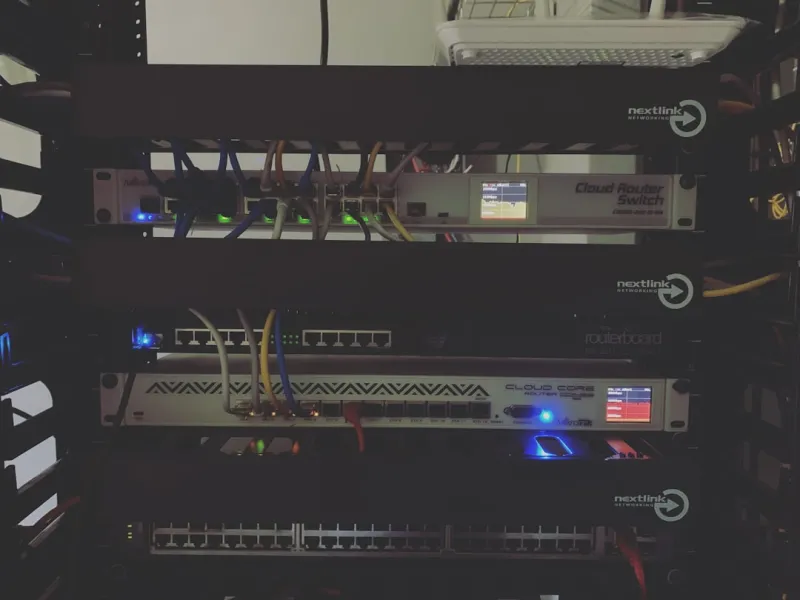
When you’ve spent years fine‑tuning a workstation for raw compute, the network often feels like an afterthought – a bland, invisible conduit that simply “works.” In 2026 that mindset is obsolete. The hyper‑connected reality of AI‑driven workloads, 8K streaming, and real‑time collaboration tools means any latency spike can cripple productivity. As a longtime power‑user, I’ve learned to treat the network as a first‑class citizen, designing it with the same rigor I apply to my CPU, GPU, and RAM choices. This article walks you through the trends that are reshaping computer networking right now, and it offers a playbook to future‑proof your setup so you stay ahead of the curve, whether you’re running a home lab, a freelance development studio, or a boutique consulting firm.
AI‑Accelerated Traffic Is Redefining Bandwidth Needs
Artificial intelligence is no longer a niche hobby; it’s a daily driver in every modern workflow. From generative image models that churn out assets in seconds to code‑assistants that autocomplete entire functions, AI workloads generate massive, bursty traffic patterns that traditional networking stacks struggle to handle. In 2026, you’ll notice a sharp rise in outbound traffic as models query cloud inference endpoints, and inbound traffic spikes as results stream back. This shift demands both higher raw throughput and smarter traffic shaping. I’ve started allocating dedicated 10 Gbps VLANs for AI traffic, separating them from my standard office traffic to avoid bottlenecks. Pair this with QoS policies that prioritize low‑latency packets, and you’ll see a noticeable reduction in job completion times. Remember, the goal isn’t just more bandwidth—it’s intelligent bandwidth that understands the unique cadence of AI workloads.
Wired Speed Is No Longer a Luxury, It’s a Baseline
Ten‑gigabit Ethernet (10 GbE) was once a niche for data centers, but by 2026 it’s the new baseline for serious power users. The price per port has fallen dramatically, making multi‑port 10 GbE NICs a viable upgrade for even a mid‑range desktop. For those who need more headroom, 25 GbE and 40 GbE switches are becoming commonplace, especially when aggregating storage traffic from NVMe‑over‑Fabric arrays. I swapped my legacy 1 GbE router for a compact 10 GbE managed switch and immediately felt the difference: large file transfers that used to take minutes now complete in seconds, and latency‑sensitive tasks like remote debugging over SSH feel buttery smooth. When selecting hardware, prioritize switches with modular SFP+ ports, allowing you to upgrade to higher‑speed optics without replacing the entire chassis. This modularity not only safeguards your investment but also ensures your network can keep pace with the relentless march of faster CPUs and GPUs.
Wi‑Fi 7 (and the Dawn of Wi‑Fi 8) Is Changing the Wireless Landscape
While wired connections dominate the back‑office, the modern power‑user rarely stays tethered. Wi‑Fi 7, officially ratified in early 2025, brings up to 30 Gbps theoretical throughput, multi‑link operation, and dramatically lower latency thanks to its 4096‑QAM modulation and 320 MHz channel width. In my home office, a Wi‑Fi 7 access point paired with a Wi‑Fi 7‑compatible laptop reduced my average ping from 28 ms to under 10 ms during cloud‑based model inference. The next iteration, Wi‑Fi 8, is already on the horizon, promising even tighter integration with AI for dynamic spectrum allocation. For power users, the key takeaway is to future‑proof your wireless infrastructure now: choose APs with modular antenna designs and support for both Wi‑Fi 7 and the upcoming Wi‑Fi 8 standards. This ensures you won’t need to replace your entire network when the next wave of devices arrives, preserving both budget and performance.
Zero‑Trust Security Isn’t Optional Anymore
Network security has evolved from perimeter‑based firewalls to a Zero‑Trust paradigm where every device, user, and application must prove its identity before gaining access. In 2026, the Power‑User Playbook for Bulletproof Encryption emphasizes that relying solely on traditional VPNs is insufficient; you need micro‑segmentation, continuous authentication, and encrypted traffic inspection at every hop. I’ve implemented a Zero‑Trust Network Access (ZTNA) solution that enforces per‑application policies, meaning my development containers can only talk to the specific Git server they need, and nothing else. Coupled with strong, post‑quantum‑ready encryption, this approach thwarts lateral movement and reduces the attack surface dramatically. For anyone handling sensitive data—be it proprietary code, client information, or AI model weights—adopting Zero‑Trust is not just a best practice; it’s a survival strategy in a world where breaches happen in days, not months.
Edge Computing and SD‑WAN Are Blurring the Cloud‑On‑Premise Divide
Edge computing is no longer a buzzword reserved for IoT manufacturers; it’s a practical solution for power users who need ultra‑low latency and data sovereignty. By deploying small, purpose‑built edge nodes in strategic locations—your office, a co‑working space, or even a coffee shop—you can process AI inference locally and only send aggregated results to the cloud. This reduces bandwidth costs and improves response times. To orchestrate these distributed nodes, Software‑Defined WAN (SD‑WAN) has matured into a robust, policy‑driven platform that can intelligently route traffic based on real‑time performance metrics. I use an SD‑WAN controller to steer AI‑heavy traffic over a dedicated 10 GbE path while relegating routine web browsing to a cheaper broadband link, all without manual reconfiguration. The result is a seamless blend of on‑premise power and cloud scalability, giving you the best of both worlds.
Building a Home Lab That Mirrors Enterprise‑Grade Networks
Power users often experiment in home labs, but many treat those environments as ad‑hoc playgrounds. In 2026, a well‑architected home lab can serve as a miniature data center, complete with redundant power supplies, modular switches, and a hyper‑converged storage cluster. Start with a rack‑mount chassis that supports both 10 GbE and 25 GbE uplinks, then add a pair of leaf switches for high‑availability routing. Deploy a virtualized network stack using platforms like VMware NSX or Proxmox VE, which let you spin up isolated VLANs for development, testing, and production workloads. By mirroring enterprise best practices—such as implementing VLAN tagging, spanning‑tree protocol optimization, and automated provisioning—you’ll gain a deeper understanding of the networks you’ll manage in professional settings. Plus, the hands‑on experience pays dividends when troubleshooting complex issues in the field, making you a more valuable asset to any organization.
AI‑Powered Monitoring and the Power‑User Network Playbook
Traditional network monitoring tools rely on static thresholds and periodic polls, which can miss the subtle anomalies that precede a failure. In 2026, AI‑driven analytics are the new norm, ingesting telemetry from every port, interface, and application to predict issues before they manifest. I’ve integrated an open‑source AI monitoring stack that correlates packet loss, jitter, and CPU utilization across my entire network fabric, automatically generating tickets when predictive models flag a risk. This proactive stance not only reduces downtime but also frees you to focus on strategic initiatives rather than firefighting. The Power‑User Network Playbook outlines the exact tools and configurations I use, from time‑series databases to custom anomaly detection scripts, giving you a roadmap to elevate your monitoring game from reactive to prescient.
Future‑Proofing: Software‑Defined Everything
Software‑Defined Networking (SDN) isn’t just for large enterprises; it’s the cornerstone of a future‑proof personal network. By abstracting the control plane from the data plane, you gain the flexibility to reprogram traffic flows on the fly, integrate new security policies, and roll out updates without physical re‑cabling. I’ve transitioned my home lab to an SDN controller that manages both wired and wireless segments, allowing me to push a new VLAN for a temporary IoT demo in seconds. Pair this with network function virtualization (NFV) to run firewalls, load balancers, and even DDoS mitigation as virtual appliances, keeping your hardware investments agile. When you couple SDN with modular hardware—switches that accept both SFP+ and QSFP28 optics—you create a network that can scale from 1 GbE to 400 GbE with a simple software tweak, ensuring you won’t be forced into a costly overhaul as bandwidth demands explode.
Putting It All Together: A Roadmap for the Modern Power User
By now you’ve seen how AI traffic, ultra‑fast wired connections, next‑gen Wi‑Fi, Zero‑Trust security, edge computing, and AI‑driven monitoring converge to form the network of 2026. The challenge is stitching these pieces into a cohesive, resilient architecture that can adapt to tomorrow’s demands. Start with a solid foundation: upgrade to a modular 10 GbE switch, deploy a Wi‑Fi 7 access point, and enforce Zero‑Trust policies across all devices. Layer AI‑powered monitoring on top, and then add SDN to give you the flexibility to pivot as new standards emerge. Finally, consult resources like how power users can future‑proof their networks for detailed checklists and migration paths. With this roadmap, you’ll not only meet today’s performance expectations but also stay ahead of the inevitable tech shifts that define the next decade of power‑user networking.