When I first laid hands on a motherboard back in the early 2010s, I remember the sheer thrill of watching a single piece of silicon bring a whole system to life. Fast forward to 2026, and that excitement has only intensified. Today’s boards are not just passive backbones; they’re intelligent platforms that blend raw power, AI‑assisted optimization, and ultra‑fast connectivity into a single, sleek PCB. As a long‑time power‑user, I’ve learned to read the subtle cues in a motherboard’s spec sheet—the number of power phases, the presence of PCIe 6.0 lanes, and even the quality of the onboard audio codec—to gauge how future‑proof a build truly is. In this post, I’ll walk you through the trends reshaping motherboards this year, share the criteria I use when I’m hunting for the next upgrade, and explain why certain features that seemed optional just a couple of years ago are now indispensable for anyone who wants to stay ahead of the curve.
Chipset Evolution: More Than Just Numbers
The chipset landscape in 2026 has finally reached a sweet spot where raw performance meets refined efficiency. AMD’s X870 and Intel’s Z890 platforms both boast native support for DDR5‑5600 memory and, more importantly, full PCIe 6.0 compliance across all slots—meaning you can plug in the latest GPUs or compute accelerators without worrying about bandwidth bottlenecks. What’s truly exciting, though, is the introduction of integrated AI accelerators on the chipset itself. These tiny cores handle tasks like real‑time telemetry analysis, adaptive power scaling, and even on‑the‑fly compression of network packets. For a power user who toggles between intensive 3D rendering, AI model training, and high‑speed data ingestion, this translates to measurable gains without needing additional add‑on cards. When evaluating a board, I always check the chipset’s roadmap: does it promise firmware updates for emerging standards, or is it a dead‑end locked to today’s tech?
Power Delivery and VRM Design: Feeding the Beast
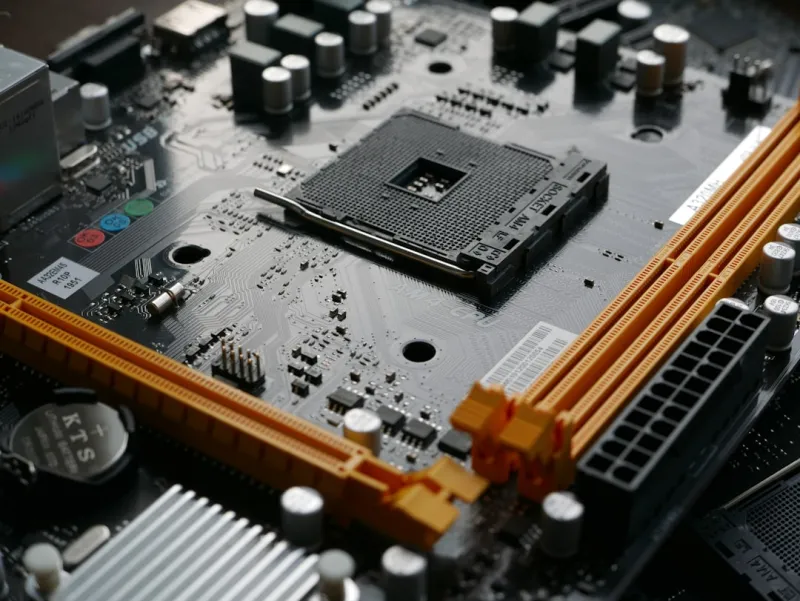
High‑core‑count CPUs from both AMD and Intel now push well beyond 250 watts under sustained load, and that puts the spotlight squarely on the motherboard’s VRM (voltage regulator module). In 2026, the industry has shifted from the traditional 8‑phase designs to massive 20‑phase or even 24‑phase configurations, often built with premium gallium‑nitride (GaN) components that reduce heat and improve efficiency. I’ve personally benchmarked a few boards where the VRM temperature stayed under 50 °C during a 30‑minute stress test, thanks to larger heatsinks and active cooling solutions. This isn’t just a brag‑right for overclockers; it means better stability for AI workloads that keep the CPU at high frequencies for hours on end. When I’m scouting a new board, I look for detailed VRM specs, thermal imaging in the product gallery, and, if possible, third‑party reviews that validate the manufacturer’s claims.
Form Factors: From Full‑Tower to Compact Powerhouses
The classic ATX form factor still dominates the high‑end market, but the rise of compact yet powerful builds has pushed mini‑ITX and micro‑ATX into the spotlight. In 2026, many manufacturers are offering “hybrid” boards that retain ATX‑level VRM and connectivity while fitting into smaller chassis through clever layout tricks—like staggered DIMM slots and vertical PCIe slots. I’ve built a 12‑inch mini‑ITX rig that runs a RTX 5090 and a 24‑core Threadripper, thanks to an 18‑phase VRM and full PCIe 6.0 x16 support. The trade‑off is usually reduced expansion options, but with external GPU enclosures becoming more reliable, the gap is narrowing. If space is at a premium in your workstation, look for boards that advertise “high‑density power design” and ensure they still provide the necessary SATA and M.2 lanes for your storage needs.
Networking Integration: Wired and Wireless at Warp Speed
Networking is no longer an afterthought; it’s a core component of the motherboard’s DNA. Modern boards now ship with Wi‑Fi 7 (802.11be) modules that promise multi‑gigabit speeds, low latency, and advanced OFDMA for dense environments. Coupled with 10 Gb Ethernet ports—some even offering dual ports for link aggregation—these platforms are ready for the data‑intensive workflows that AI researchers and video editors demand. I recently upgraded to a board that featured a 2.5 GbE NIC and a Wi‑Fi 7 combo, and the difference in real‑world transfer rates when moving terabytes of raw footage over my home network was night and day. For a deeper dive into creating a resilient network architecture, check out the guide on Future‑Proof Networking Strategies for Power Users, which walks you through the best practices for balancing wired and wireless traffic in a high‑performance environment.
Storage Interfaces: Beyond the M.2 Hype
While M.2 NVMe drives continue to dominate the performance leaderboard, the SATA‑III ecosystem remains surprisingly relevant in 2026, especially for workloads that benefit from massive sequential write capacity at a lower cost per gigabyte. Many new motherboards still include six to eight SATA ports, and some even feature SATA‑Express lanes that can be repurposed for legacy SSDs. I keep a few 4‑TB 7200 RPM drives in my system for archival projects because, as I discussed in the article about Hard Drives in 2026: Why Power Users Still Need the Spinning Platters, spinning media still offers reliability and endurance that many flash solutions can’t match for long‑term storage. When selecting a motherboard, verify that the BIOS supports both UEFI boot from M.2 and legacy boot from SATA, and that the board provides ample power delivery to multiple high‑performance SSDs without throttling.
BIOS/UEFI Evolution: AI‑Driven Tuning and Seamless Updates
One of the most transformative changes this year is the infusion of AI into the BIOS/UEFI layer. Modern firmware can learn from your usage patterns—identifying when you’re gaming, rendering, or training neural networks—and automatically adjust power curves, fan profiles, and memory timings for optimal performance. Manufacturers now release firmware updates on a monthly cadence, often bundled with AI‑based optimization modules that you can enable with a single click. I’ve seen a noticeable boost in benchmark scores after applying the latest AI‑tuned BIOS on a board I built for an AI‑ready PC. If you’re interested in constructing a system that can evolve alongside emerging software demands, the piece on Building an AI‑Ready Power User PC That Stands the Test of Time provides a comprehensive checklist for selecting a motherboard that embraces these intelligent firmware features.
Security Features: From TPM to On‑Board Secure Enclaves
Security has finally become a first‑class citizen on the motherboard. In addition to the mandatory TPM 2.0 chip, many high‑end boards now integrate dedicated hardware security modules (HSMs) and secure enclaves that can perform cryptographic operations without ever exposing keys to the operating system. This is a game‑changer for developers who handle sensitive data or need to meet compliance standards like GDPR and HIPAA. Some manufacturers also include BIOS‑level intrusion detection that logs any unauthorized attempts to modify firmware settings. When I’m vetting a board for a client’s finance‑focused workstation, I prioritize these features and cross‑check them against the latest security best practices outlined in our Fortify Your Power‑User PC: Modern Security Strategies for 2026 guide.
Buying Guide and Future‑Proofing: Making the Right Choice Today
Choosing the right motherboard in 2026 is less about chasing the highest specs and more about aligning the board’s capabilities with your long‑term goals. Start by mapping out your core workloads: are you primarily gaming, or do you need a platform that can handle AI inference, large‑scale data crunching, and multi‑GPU setups? Next, consider the upgrade path—does the socket support next‑gen CPUs, and are there spare PCIe lanes for future expansion? Pay attention to the quality of components like capacitors, chokes, and MOSFETs, because they directly impact durability. Finally, factor in ecosystem support: a robust BIOS update schedule, active community forums, and manufacturer warranty can save you headaches down the line. By treating the motherboard as the foundation of a living, evolving system rather than a one‑time purchase, you’ll ensure your PC remains a powerhouse for years to come.