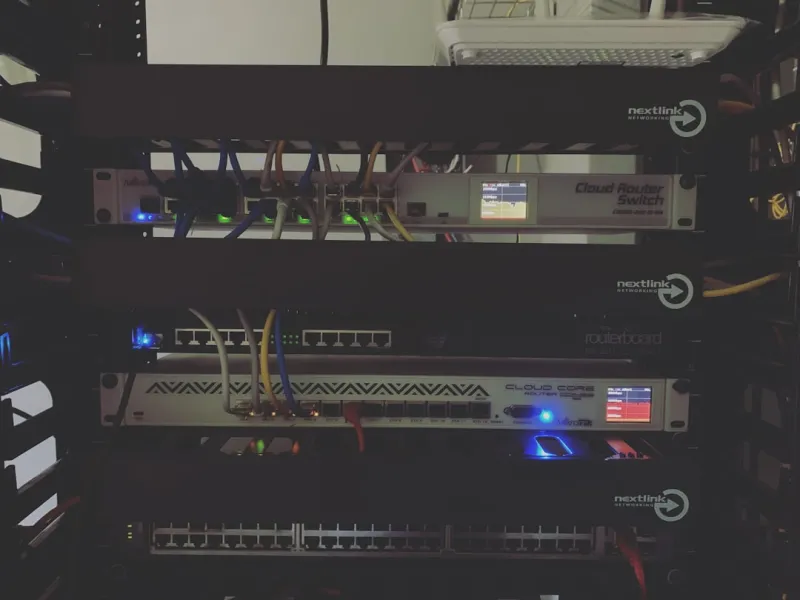
When I first started tinkering with routers back in the early 2010s, my biggest worry was whether my Wi‑Fi signal would survive a rainy afternoon. Fast‑forward to 2026, and the very notion of “signal strength” feels quaint compared to the data‑centric, AI‑infused networks that now power everything from smart factories to remote‑learning classrooms. As someone who lives at the intersection of hardware tinkering and enterprise consulting, I’m constantly reminded that networking isn’t just about cables and IP addresses—it’s the nervous system of the digital world. Today’s networks must anticipate threats before they arrive, allocate bandwidth dynamically based on AI‑predicted workloads, and do it all while keeping latency low enough for immersive AR experiences. In this post, I’ll unpack the three forces reshaping networking this year: artificial intelligence, zero‑trust architectures, and edge‑centric hardware, and I’ll share actionable tips you can apply whether you run a home lab or a multinational data center.
AI as the Network’s Brain
Artificial intelligence has graduated from a “nice‑to‑have” analytics tool to the core decision‑making engine of modern networks. Machine‑learning models now sit inside switches, routers, and even firmware, constantly ingesting telemetry—from flow records to packet‑level latency metrics—to predict congestion before it manifests. In practice, this means your network can automatically reroute traffic when a sudden surge in video‑conference usage threatens to choke a critical link, all without human intervention. The beauty of AI‑driven routing is its ability to learn from historical patterns while adapting to novel workloads, such as the bursty traffic generated by generative AI services that dominate today’s cloud workloads. If you’re curious about the broader implications, my deep‑dive on Future‑Ready Networking: AI, Edge, and Zero‑Trust in 2026 explores how these predictive models are being woven into every layer of the stack.
Zero‑Trust: From Perimeter to Fabric
Zero‑trust used to be a buzzword that most enterprises relegated to the DMZ, but in 2026 it’s an operating principle embedded directly into the networking fabric. Rather than assuming everything inside the corporate perimeter is safe, modern zero‑trust frameworks continuously verify every device, user, and service, regardless of location. This shift is powered by strong identity‑based policies, micro‑segmentation, and real‑time risk scoring driven by AI. For network engineers, the practical upshot is a move away from flat VLANs toward granular policy enforcement points that sit at the hypervisor, the switch ASIC, and even the NIC. The result? A breach can be isolated to a single pod or container within seconds, dramatically limiting lateral movement. My earlier piece Why Modern Computer Security Demands a Zero‑Trust, AI‑First Approach lays out the strategic roadmap for making this transition without tearing down existing infrastructure.
Edge Computing Meets Intelligent Switching
The rise of edge computing has forced networks to become more distributed, and with distribution comes the need for intelligent, low‑latency processing at the edge nodes themselves. Today’s edge devices—whether they’re industrial IoT gateways or 5G small cells—are equipped with smart NICs that offload encryption, packet inspection, and even AI inference to hardware, freeing the CPU for core application workloads. This convergence of edge and intelligent switching reduces round‑trip times for latency‑sensitive applications like autonomous vehicle coordination or real‑time VR collaboration. Moreover, edge nodes can now act as mini‑data‑centers, running federated learning models that improve overall network performance while respecting data‑privacy regulations. The hardware advances discussed in Unlocking the Future of Computer Networking: AI, Zero‑Trust, and Hardware Innovation illustrate how programmable ASICs and DPUs are making this vision a reality.
Hardware Innovation: The Quiet Revolution
While software gets most of the headlines, the silent revolution happening in silicon is what truly enables AI‑driven, zero‑trust networks. Modern routers and switches now ship with integrated DPUs (Data Processing Units) that handle encryption, deep packet inspection, and even AI inference without burdening the main CPU. This offload capability is crucial as encryption becomes a non‑negotiable baseline, as I argued in “Why Strong Encryption Is No Longer a Luxury—It’s a Necessity”. The result is a network that can inspect every packet at line rate while maintaining sub‑millisecond latency. Additionally, the emergence of programmable switch fabrics allows administrators to inject custom security policies directly into the data plane, creating a dynamic barrier that can adapt to emerging threats in real time. For builders, this means selecting hardware that supports open APIs, such as those defined by the Open Network Linux (ONL) community, to future‑proof deployments against the inevitable wave of new protocols and AI workloads.
Security Challenges: The New Attack Surface
Even as AI and zero‑trust tighten our defenses, they also expand the attack surface. Adversaries are now leveraging AI to craft sophisticated, low‑volume attacks that evade traditional signatures, and they target the very ML models that power network optimization. To stay ahead, organizations must adopt a defense‑in‑depth strategy that includes continuous model validation, adversarial testing, and automated rollback mechanisms. Encryption, again, plays a pivotal role; end‑to‑end encryption ensures that even if a malicious actor gains foothold on an edge node, the payload remains unreadable. However, encryption alone isn’t sufficient—key management must be automated and integrated with identity platforms to avoid human error. This layered approach mirrors the recommendations in my “Inside the Malware War: Why 2026 Threats Need a New Defense Playbook”, where I detail how AI‑enabled detection combined with zero‑trust policies can dramatically reduce breach dwell time.
Real‑World Adoption: A Case Study
Consider the story of a mid‑size manufacturing firm that recently upgraded its plant floor network to a fully AI‑enabled, zero‑trust architecture. By deploying smart switches with embedded DPUs and integrating an AI‑based traffic‑analysis engine, the company reduced network‑induced production downtime by 38% within the first quarter. Simultaneously, they rolled out a micro‑segmentation policy that isolated each CNC machine’s control traffic, preventing a ransomware outbreak from spreading beyond a single workstation. The ROI was compelling: not only did operational efficiency improve, but the firm also avoided a potential $1.2 million loss from a hypothetical breach. Their journey underscores that the combination of AI, hardware acceleration, and zero‑trust isn’t just theoretical—it delivers measurable business value across the board.
Practical Steps for Small and Medium Enterprises
If you’re running a small to medium enterprise (SME) and feel overwhelmed by the buzz, start with three manageable actions. First, audit your existing network topology and identify high‑risk segments—these are prime candidates for micro‑segmentation. Second, upgrade at least one core switch to a model that supports programmable data planes and DPU offload; many vendors now offer entry‑level options that don’t break the bank. Third, deploy an AI‑driven monitoring tool that can alert you to anomalous traffic patterns in real time; many SaaS platforms provide plug‑and‑play integrations that work with legacy equipment. By taking these incremental steps, you can begin to reap the benefits of AI‑enhanced security without a massive capital overhaul. Remember, the goal isn’t to achieve a perfect, all‑encompassing network overnight but to build a resilient foundation that can evolve as threats and workloads change.
The Road Ahead: Embrace the Evolution
Looking forward, the convergence of AI, zero‑trust, and edge‑centric hardware will only accelerate. As 5G matures and quantum‑resistant encryption becomes mainstream, networks will need to adapt at a pace we’ve never seen before. For professionals like us who love to stay ahead of the curve, the challenge is to remain curious, experiment with new protocols, and share findings with the community. The future of networking is not a distant horizon; it’s being built in today’s data centers, on today’s factory floors, and even in our home labs. By embracing AI‑driven insights, enforcing zero‑trust at every layer, and investing in smart hardware, you’ll position yourself—and your organization—to thrive in the hyper‑connected world of 2026 and beyond.