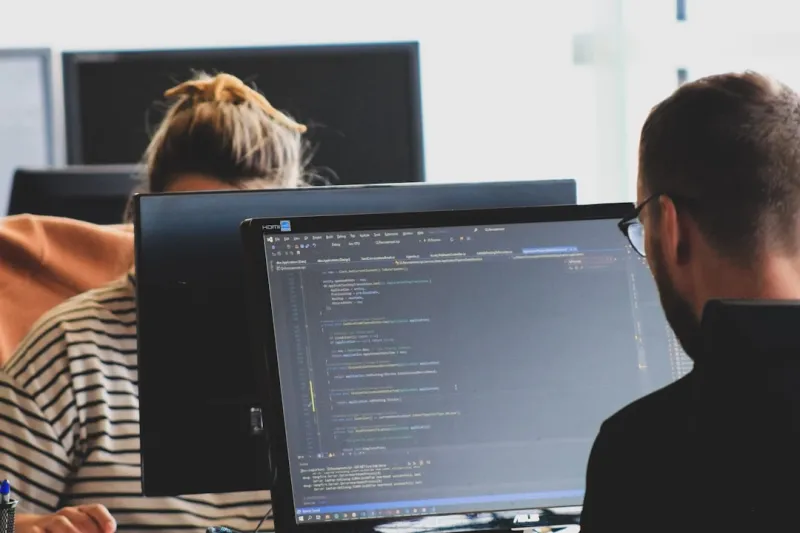
When I first started writing code in the early 2000s, the biggest headache was getting my compiler to accept the syntax I’d painstakingly crafted. Fast forward to 2026, and the landscape has mutated into a sprawling ecosystem of AI‑augmented tools, containerized runtimes, and hyper‑personalized hardware configurations. The modern software developer is no longer just a coder; we’re a power‑user, orchestrating an entire stack of services, data pipelines, and dev‑ops rituals that must dance in perfect sync. This shift isn’t a fleeting trend—it’s a permanent evolution that demands a new mindset, one that blends the curiosity of a tinkerer with the rigor of an engineer. In this post, I’ll walk you through the mental models, toolchains, and hardware philosophies that can turn a good developer into a true power‑user, ready to tackle the challenges of 2026 and beyond.
The Hybrid Edge of Modern Development
At the heart of today’s software renaissance lies a hybrid edge: the convergence of traditional monolithic thinking with cloud‑native, serverless, and edge‑computing paradigms. This hybrid approach forces us to ask, “Where does my code live, and how does it get there?” The answer isn’t a single platform but a mosaic of environments, each with its own performance profile and security posture. To thrive, you must treat the deployment pipeline as an extension of your IDE, scripting not just builds but also the provisioning of resources across AWS, Azure, and emerging edge nodes. By embracing this mindset, you’ll discover opportunities to shave milliseconds off latency, reduce costs, and dramatically improve the end‑user experience. It’s a demanding mental shift, but the payoff is a development workflow that feels as fluid as the code you write.
AI‑Powered Toolchains: From Autocomplete to Autonomous Refactoring
Artificial intelligence has moved from the realm of novelty to the core of our daily coding routines. Tools like GitHub Copilot have become ubiquitous, but the real power lies deeper—in AI‑driven static analysis, automated test generation, and even autonomous refactoring engines that can restructure codebases without human intervention. I’ve integrated these capabilities into my own workflow, letting an AI suggest performance‑critical optimizations while I focus on business logic. The synergy is best captured in AI Computing Unleashed: Power‑User Strategies for 2026, where we explore how to harness large language models not just for code completion but for predictive debugging and intelligent code reviews. The key is to treat AI as a collaborative partner: set clear expectations, provide high‑quality prompts, and always validate the output. When done right, AI reduces the cognitive load, letting you allocate mental bandwidth to architecturally complex problems that still require human intuition.
Hardware as Code: When the Machine Becomes Your IDE
Power‑users have long understood that software performance is inseparable from the underlying hardware. In 2026, that truth has crystallized into the concept of “hardware as code.” By scripting BIOS configurations, GPU allocations, and even RAM timings, you can spin up development rigs that are perfectly tuned for your workload—whether you’re training a transformer model locally or profiling low‑level kernel interactions. Tools like Terraform now have providers for workstation provisioning, allowing you to version‑control every knob on your machine. This granular control translates into reproducible performance benchmarks and eliminates the “it works on my machine” excuse. Moreover, modern CPUs with built‑in AI accelerators and high‑bandwidth memory open doors for on‑device inference that were unimaginable a few years ago. Embracing this hardware‑centric mindset ensures that your software not only runs but thrives on the exact specs you dictate.
Balancing Cloud‑Native Flexibility with Edge Responsiveness
While the cloud offers scalability, the edge promises ultra‑low latency, especially critical for real‑time applications like AR/VR, IoT, and autonomous systems. The challenge for a power‑user is to architect a seamless handoff between these domains. This means designing stateless services that can be deployed both in a Kubernetes cluster and as lightweight containers on edge gateways. Observability stacks must aggregate telemetry from both cloud and edge nodes, providing a unified view of performance. By leveraging technologies such as Service Meshes and edge‑first APIs, you can abstract away the underlying infrastructure, letting your code adapt dynamically based on network conditions. The result is a resilient system that delivers consistent experiences, regardless of where the user’s request originates. Mastering this duality is a hallmark of the modern power‑user, turning geographic dispersion from a limitation into a strategic advantage.
The Operating System as a Strategic Asset
In an era where containers and virtual machines dominate, the underlying operating system often gets overlooked. Yet, for a power‑user, the OS is a strategic asset that can be fine‑tuned to squeeze out performance gains and enhance security. Modern OSes now support sandboxed workloads, granular permission models, and built‑in AI inference pipelines that can offload compute from user‑space applications. Understanding the nuances of Windows, Linux, and emerging hybrid OSes empowers you to select the right platform for each component of your stack. The article Why Modern Operating Systems Matter More Than Ever for Power Users delves into these considerations, highlighting how OS‑level features like Windows Subsystem for Linux (WSL) 2 and Linux kernel live patching can dramatically streamline development pipelines. By aligning your OS choices with your project’s performance and security requirements, you gain a hidden layer of optimization that many developers simply ignore.
Continuous Learning: From Community to Personal Knowledge Graphs
Power‑users never stop learning, but the method of knowledge acquisition has evolved. Instead of passively consuming blog posts, we now build personal knowledge graphs that interlink concepts, code snippets, and tooling insights. Platforms like Obsidian and Roam Research allow us to map relationships between, say, a new Rust macro and its impact on compile‑time performance, creating a living repository of expertise. Pair this with community‑driven resources—GitHub discussions, Discord channels, and niche newsletters—and you have a feedback loop that accelerates skill acquisition. The habit of regularly contributing back to these ecosystems, whether through open‑source patches or tutorial write‑ups, reinforces your own understanding while elevating the entire community. In short, treat learning as a codebase: version it, refactor it, and test it.
Your Power‑User Playbook for 2026
Putting theory into practice requires a concrete checklist. First, audit your development environment: script your IDE settings, terminal configurations, and hardware profiles so you can recreate them on any machine. Second, integrate AI assistants into your CI/CD pipeline—use them for automated code reviews and to generate unit tests for newly added functions. Third, adopt a hybrid deployment strategy: containerize services for the cloud but also build lightweight edge images for latency‑sensitive components. Fourth, lock down your OS with the latest security patches and enable sandboxing for untrusted code. Fifth, document every decision in a personal knowledge graph, linking to relevant internal resources like The Hybrid Edge: Why Modern Software Development Demands a Power‑User Mindset. Finally, schedule quarterly “power‑user retrospectives” where you evaluate tooling effectiveness, performance metrics, and learning goals. Follow this playbook, and you’ll not only keep pace with industry changes—you’ll set the tempo.
Looking Ahead: The Future of Power‑User Development
The next wave of software development will be defined by deeper AI integration, more sophisticated edge architectures, and an ever‑shrinking gap between hardware and software. As power‑users, our role is to stay ahead of these trends, turning every new capability into a lever for productivity and innovation. By cultivating a hybrid mindset, leveraging AI as a collaborative partner, and treating hardware and operating systems as code, we position ourselves at the nexus of technology’s most exciting advances. The journey won’t be easy—there will be steep learning curves, broken pipelines, and occasional AI‑generated missteps—but the rewards are proportional. In 2026 and beyond, the true differentiator will be the developers who can orchestrate complex ecosystems with the finesse of a conductor, delivering software that’s not just functional but truly transformative.