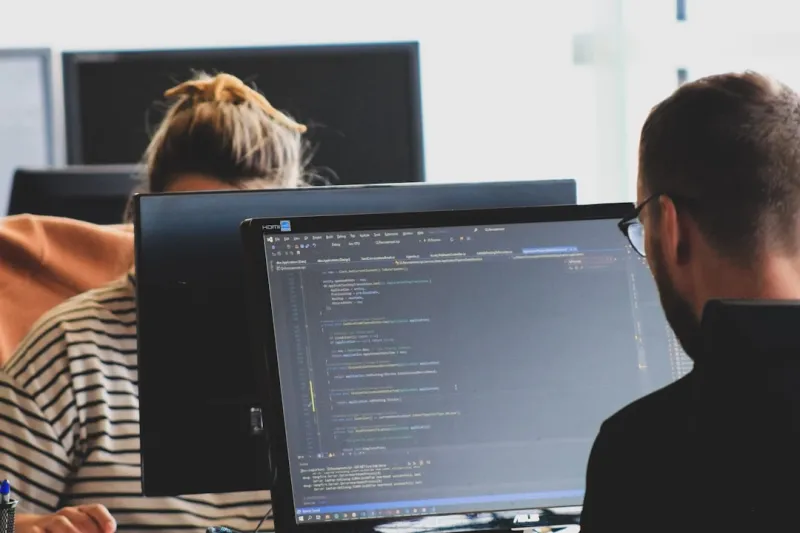
Software development in 2026 feels like a perpetual sprint through a hyper‑connected marathon. Every day, I wake up to a cascade of AI‑generated pull‑request suggestions, cloud‑native test environments that spin up in seconds, and a relentless pressure to ship features without sacrificing stability. The biggest shift I’ve observed is the blurring line between the developer’s workstation and the production cloud—thanks to “in‑the‑box” observability tools that let you debug a live microservice from your IDE as easily as you’d step through local code. This new reality forces power users like us to treat our development rigs not just as coding stations but as hybrid gateways to distributed systems. It also means we can no longer afford to overlook the fundamentals: a responsive keyboard, a display that honors true‑color fidelity, and a network stack that can keep up with gigabit‑scale data streams. When these basics are solid, the rest of the stack—AI assistants, serverless back‑ends, and real‑time collaboration—falls into place, allowing us to iterate faster while keeping the dreaded “it works on my machine” excuse at bay.
Designing a Development Rig That Won’t Age Out
When I talk about a future‑proof development rig, I’m not just listing the newest CPU or the flashiest GPU. I’m focusing on modularity, thermal efficiency, and upgrade pathways that align with a power‑user’s budget and workflow. A solid foundation starts with a motherboard that supports PCIe 5.0, DDR5 memory, and multiple M.2 slots—features that let you swap in faster storage or expand GPU capacity without a full rebuild. Pair that with a high‑refresh, color‑accurate monitor, and you have a visual canvas that honors both UI design and data‑intensive debugging. I recently revisited Building a Future‑Proof Development Rig: Power‑User Strategies for 2026 and was reminded how critical it is to future‑proof power and cooling. A robust power supply with an 80 PLUS Gold rating, a well‑designed airflow plan, and a chassis that accommodates larger coolers will keep temperatures low, extending component life and reducing throttling during long compile sessions.
Selecting the Operating System That Matches Your Stack
Choosing an OS in 2026 is less about personal preference and more about aligning with the ecosystems you serve. Linux distributions continue to dominate container orchestration, while Windows has made strides with WSL 2, offering near‑native Linux kernel performance inside a familiar UI. For developers who juggle cross‑platform mobile builds, a dual‑boot setup or a VM strategy can eliminate the “wrong tool for the job” syndrome. The article The Operating System Choices Power Users Must Make in 2026 dives deep into the trade‑offs, but my personal workflow hinges on a primary Linux environment for server‑side work, complemented by Windows for .NET and legacy enterprise tools. The key is to leverage WSL 2 for seamless file system integration, ensuring that your IDE sees the same file permissions and line endings as the target production container. This reduces friction and cuts down on “works on Linux, fails on Windows” bugs that once plagued multi‑OS teams.
Security Is Not an Afterthought—It’s a Core Development Concern
Modern software development is inseparable from security, especially as supply‑chain attacks become more sophisticated. Encrypting everything at rest and in transit is now a baseline expectation, not a nice‑to‑have feature. I made a habit of revisiting my security posture every sprint, ensuring that secrets are stored in vaults, code is signed, and binaries are verified before deployment. The guide Encrypt Everything: A Power‑User’s Guide to Modern Data Security offers a concise checklist that I embed into my CI pipelines, automatically rejecting any artifact that lacks proper encryption metadata. Moreover, adopting a zero‑trust model within the development environment—where each tool, container, and service authenticates independently—helps mitigate lateral movement if a breach does occur. By integrating security tooling directly into your IDE, you can catch misconfigurations early, turning what used to be a post‑release audit into a continuous, automated safeguard.
CI/CD Pipelines That Keep Pace With AI‑Assisted Development
Continuous Integration and Continuous Deployment have evolved from simple build‑test‑deploy loops into intelligent, data‑driven orchestration layers. In 2026, AI‑driven code analysis tools can predict flaky tests, recommend optimal resource allocation, and even suggest refactors before a merge request lands. To keep up, I’ve configured my pipelines to run static analysis, unit tests, and contract verification in parallel, leveraging serverless compute bursts to shave minutes off each run. The trick is to maintain a balance: too many parallel jobs can overwhelm shared resources, while too few can bottleneck delivery speed. I also embed performance benchmarks that compare the latest commit against a baseline, automatically flagging regressions that might be invisible to functional tests. This approach not only speeds up feedback loops but also creates a data lake of build metrics that can be fed back into AI models, creating a virtuous cycle of continuous improvement.
AI Pair Programming: Friend or Foe?
The rise of AI pair programmers—think GitHub Copilot, Tabnine, and emerging open‑source alternatives—has sparked both excitement and skepticism across dev teams. In my experience, the most productive setups treat the AI as a junior developer: it suggests snippets, auto‑completes boilerplate, and surfaces documentation, but the human still holds the reins on architectural decisions and edge‑case handling. The real power comes when you couple AI suggestions with rigorous code reviews that enforce style guides and security standards. By integrating AI into the pull‑request workflow, you can surface potential vulnerabilities or anti‑patterns before they merge, effectively turning the AI into a proactive reviewer. However, overreliance can erode critical thinking, so I schedule regular “AI‑free” coding days to keep my problem‑solving muscles sharp. The sweet spot is a collaborative rhythm where AI augments productivity without replacing the nuanced judgment that only seasoned developers bring to complex systems.
Observability: Turning Logs Into Actionable Insights
Observability has matured from a post‑mortem luxury to a real‑time development imperative. Modern toolchains now expose distributed traces, metrics, and logs directly within the IDE, allowing you to step through a request from frontend to backend without leaving your code editor. I rely on an observability stack that aggregates OpenTelemetry data, correlates it with Git commits, and surfaces anomalies as inline warnings. This tight integration means that a performance regression introduced by a new library version appears as a highlighted line in the diff, prompting immediate investigation. Additionally, setting up alert thresholds based on historical baselines helps catch regressions before they affect users. By treating observability as a first‑class citizen of the development workflow, you reduce mean time to detection (MTTD) and mean time to recovery (MTTR), ultimately delivering more reliable software at a faster cadence.
Future‑Proofing Your Career in an AI‑Dominated Landscape
Beyond hardware and tooling, the most critical investment you can make in 2026 is in your own skill set. AI will automate routine coding tasks, but the demand for architects who can design resilient, scalable systems remains high. I allocate time each week to explore emerging paradigms—such as edge‑native computing, serverless orchestration, and quantum‑ready algorithms—while also deepening expertise in foundational concepts like distributed consensus and security protocols. Certifications still hold value, but real mastery comes from building side projects that push the boundaries of what current platforms can do. Mentorship, too, is a two‑way street; teaching junior developers forces you to articulate complex ideas clearly, reinforcing your own understanding. By staying curious, continuously learning, and sharing knowledge, you position yourself not just as a developer, but as a strategic problem‑solver who can navigate the rapid changes that define our industry.
Take the Next Step: Build, Secure, and Iterate
If you’re reading this and feel the itch to upgrade your development setup, start small but think big. Audit your current rig for bottlenecks—maybe it’s a storage lane that can’t keep up with large Docker images or a CPU that throttles under prolonged builds. Apply the security checklist from the encryption guide, integrate AI assistance responsibly, and weave observability directly into your codebase. Remember, the goal isn’t a perfect setup out of the gate; it’s a continuously evolving environment that scales with your ambitions. The power‑user mindset is all about iterative improvement, leveraging the best tools while staying grounded in core engineering principles. So, take one actionable step today—whether that’s swapping out an SSD, enabling WSL 2, or adding an automated security scan—and watch how it compounds over weeks and months. The future of software development is already here; it’s just waiting for you to claim it.