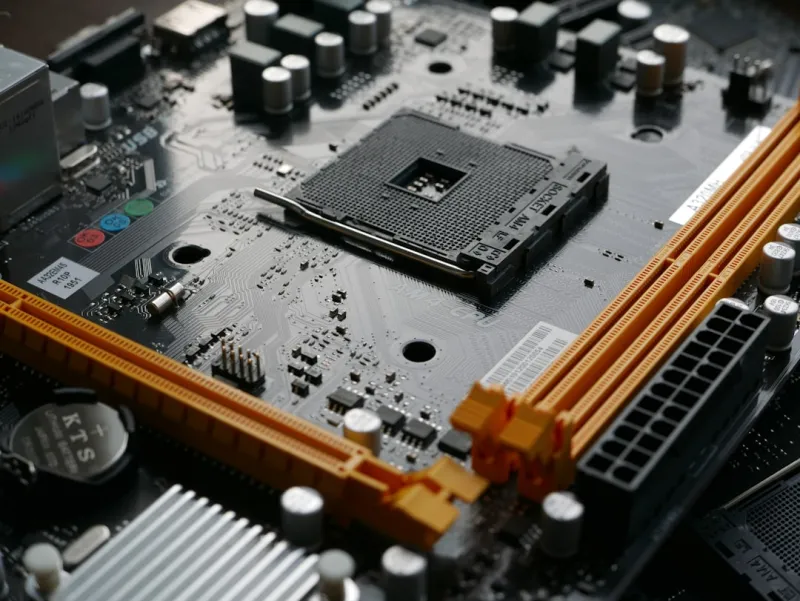
When I first cracked open a motherboard back in 2014, I never imagined the leap we’d witness by 2026. Today, the board that once simply held a CPU, RAM, and a handful of slots has transformed into a sophisticated hub for AI accelerators, ultra‑fast storage, and next‑gen security. The modern motherboard is no longer a passive platform; it actively shapes performance, power efficiency, and even the resilience of your entire system against evolving threats. In this deep dive, I’ll walk you through the trends that are redefining motherboard design this year, from chipsets that whisper AI instructions to power delivery systems that rival small data‑center modules. Whether you’re a creator pushing 8K video rendering, a gamer chasing 240 Hz frames, or a developer tinkering with edge AI, the board you choose will dictate how far you can push the hardware envelope in 2026 and beyond.
Chipset Evolution: The Brain Behind the Board
2026’s chipsets have finally caught up with the AI‑first mindset that’s been dominating the industry. AMD’s X700 series and Intel’s Z8 Extreme both embed dedicated AI inference engines, allowing off‑load of tasks like image upscaling and voice enhancement directly to the motherboard. These integrated engines reduce latency compared to sending data to a discrete GPU, and they free up valuable GPU cores for graphics‑intensive workloads. Moreover, the new chipsets support up to 64 PCIe 6.0 lanes, meaning you can populate multiple high‑speed GPUs, NVMe SSDs, and even emerging compute modules without bottlenecking. The real kicker is the dynamic power budgeting that intelligently redistributes power between the CPU, AI engine, and peripheral slots based on workload, delivering a seamless experience whether you’re streaming, gaming, or running heavy AI inference pipelines.
Power Delivery & VRM: From Simple to Supercharged
Power delivery has turned into an art form on today’s boards. The average enthusiast motherboard now ships with 18+2 phase VRM designs, employing gallium‑nitride (GaN) MOSFETs that cut heat generation by up to 30 % compared to traditional silicon devices. This not only keeps the CPU cool under sustained 5 GHz+ overclocks but also stabilizes the power rails for upcoming high‑core‑count processors that can draw 300 W or more under load. Enhanced thermal pads, vapor‑chamber heatsinks, and even small‑form‑factor liquid cooling loops are becoming standard, especially on boards targeting AI workstations. Coupled with the shift to DDR5‑6000 and the early rollout of DDR6 modules, the board must juggle higher memory frequencies while maintaining signal integrity, a challenge that modern VRM designs meet through tighter trace routing and on‑board signal‑conditioning chips. The result is a motherboard that feels like a miniature power‑plant, ready to feed the most demanding silicon of 2026.
Connectivity That Keeps Up With Speed
If you thought USB was dead, think again. Motherboards now come equipped with up to eight USB4 ports, each capable of 40 Gbps, and they double as Thunderbolt 4 hubs for external GPUs and high‑resolution displays. PCIe 6.0 has become the baseline, delivering 64 GT/s per lane, which translates to raw throughput that can fully saturate the fastest NVMe SSDs and next‑generation external storage arrays. Speaking of storage, many boards now feature integrated “Smart Storage Controllers” that combine RAID, encryption, and AI‑driven wear‑leveling into a single chip, optimizing both performance and data reliability. On the wireless front, Wi‑Fi 7 with 30 Gbps theoretical speeds and integrated Thread mesh networking are now standard, ensuring low‑latency, high‑bandwidth connections for cloud‑linked AI workloads. This connectivity suite ensures that the motherboard acts as a central hub, eliminating the need for add‑on cards that used to clutter the case.
Form Factors: Size Matters, But So Does Flexibility
The classic ATX footprint is still popular, but 2026 has seen a resurgence of specialized form factors designed for niche markets. Mini‑ITX boards, once limited to low‑power builds, now sport full‑size VRMs, PCIe 6.0 x16 slots, and even integrated AI accelerators, making them viable for compact AI edge devices. Meanwhile, the new “E‑Flex” form factor expands on E‑ATX, offering extra space for dual‑socket configurations and additional M.2 slots without sacrificing structural rigidity. This flexibility is crucial for creators who need a small chassis for portability but still demand the bandwidth of a full‑size workstation. Manufacturers are also experimenting with modular motherboard sections—think plug‑and‑play expansion panels for additional storage or networking—that can be swapped out without a full board replacement, extending the lifespan of a system across multiple hardware generations.
BIOS/UEFI Innovations: AI‑Guided Tuning and Security
The firmware layer has finally embraced the AI wave. Modern UEFI interfaces now include an “AI‑Assist” mode that monitors system behavior, predicts optimal voltage and frequency curves, and applies them in real time, delivering performance gains of up to 7 % without manual tweaking. This feature learns from each boot, gradually refining its profile to match your typical workloads—whether it’s long‑duration rendering sessions or bursty gaming spikes. Security has also been hardened: hardware‑rooted trust mechanisms now integrate TPM 2.2 with on‑board cryptographic accelerators that handle encryption duties without taxing the CPU. For those interested in the broader impact of AI on PCs, check out how AI computing is reshaping personal computers for deeper insight into these firmware advancements.
Motherboard Security: From TPM to Real‑Time Threat Mitigation
Security is no longer an afterthought; it’s baked directly into the silicon. In 2026, every reputable motherboard includes a dedicated security enclave that runs a lightweight hypervisor, isolating the boot process from potential firmware attacks. This enclave works hand‑in‑hand with the operating system’s secure boot, ensuring that only signed drivers and OS kernels load. Additionally, many boards now ship with integrated intrusion detection sensors that can detect physical tampering or anomalous voltage changes—common precursors to hardware‑based attacks. Coupled with the ever‑growing importance of encryption, the hardware‑level crypto accelerators you see on newer motherboards can handle AES‑256, RSA‑4096, and post‑quantum algorithms at line speed, making “software‑only” encryption feel obsolete. For a broader view on safeguarding your system, see how to future‑proof your computer security in 2026.
Future‑Proofing: Compatibility and Memory Diagnostics
Choosing a motherboard today means thinking several years ahead. With the CPU roadmap extending into 2028, a forward‑compatible board should support the upcoming socket revisions, offer at least four M.2 slots for NVMe drives, and include BIOS updates that can be applied over the network. Memory compatibility is another crucial factor; DDR5 is still dominant, but DDR6 is on the horizon, and many 2026 boards already feature dual‑DIMM slots capable of handling both standards via firmware negotiation. If you encounter instability, the on‑board diagnostics now include a built‑in memory error‑logging system that correlates ECC data with CPU load patterns, dramatically simplifying troubleshooting. For those needing a step‑by‑step guide, the article How to Diagnose and Fix Memory Problems in Your 2026 PC offers practical tips to keep your system humming.
Buying Guide: What to Look for in a 2026 Motherboard
When the time comes to upgrade, start by matching the motherboard’s chipset to your primary use case—AI‑centric workloads benefit from integrated inference engines, while pure gaming rigs may prioritize ultra‑low latency PCIe lanes. Verify that the VRM design meets or exceeds the power requirements of your chosen CPU, especially if you plan on overclocking. Check for a robust connectivity suite: at least two PCIe 6.0 x16 slots, multiple USB4 ports, and integrated Wi‑Fi 7. Security features such as TPM 2.2, hardware encryption, and real‑time intrusion detection are non‑negotiable for a future‑proof build. Lastly, consider the form factor—make sure your case can accommodate the board’s dimensions and any additional cooling solutions you might need. By focusing on these criteria, you’ll ensure that your motherboard not only powers today’s demanding applications but also stands ready for the innovations that 2026 and beyond will bring.